|
Ellen
von Unwerth
|
|
Ellen
von Unwerth has a unique ability to get under the skin of her subjects,
resisting any inclination to let them pose or preen. Even her sexiest
photos have a playfulness that diffuses the fact that the viewer is looking
at a nearly naked (or completely naked) body. We see characters knowing
and experienced, but the faces still have the aspect of innocence lacking
in the work of many a male photographer. Much has been made of von Unwerth's
former career as a model, which enables her to have a special connection
to those she shoots. "It was actually very accidental," says von Unwerth,
on the phone during a break at her studio in Manhattan. "I didn't know
I had a talent [for photography]. My boyfriend gave me a camera and I
started snapping my friends, and I got real passionate about it. Everyone
was surprised a model could do something creative. Everyone says they're
stupid, which is not true, but in a way when you model you're so occupied
with it, it's hard to think about anything else.
If she fell into photography, she also fell into the modeling world.
|
|
Ellen
|
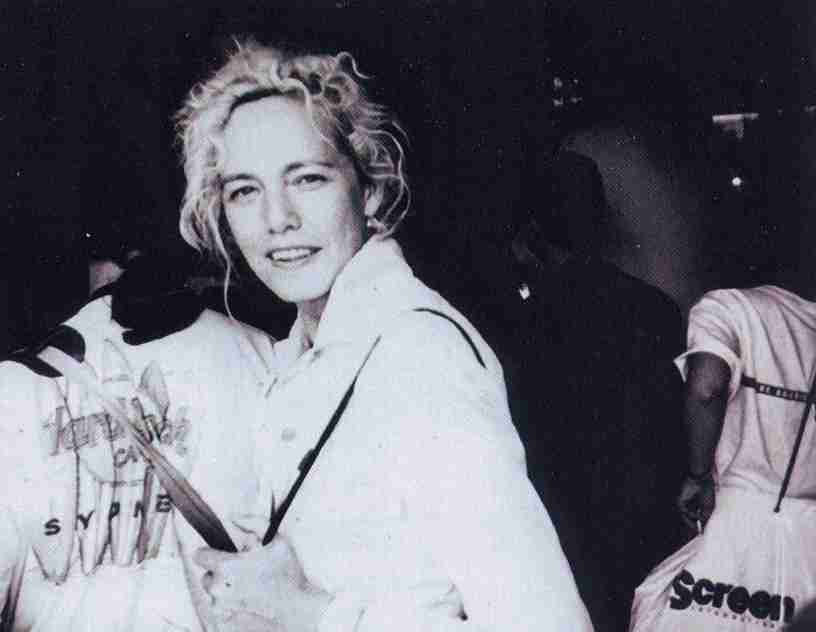
|
Von
Unwerth
|
| The
German-born von Unwerth started her career in the rather lyrical job of
circus assistant. "I was always fascinated with the circus. Even now I shoot
a lot of circus stuff. The circus I worked for was a very poetic circus
in Munich. Austrian singers and poets created it and when I saw it, I said,
'I have to join!' I fell in love with the MC of the circus-it was very romantic.
I was the assistant of the clown and the magician and the man who throws
the knife." While she was living out this dream, von Unwerth was discovered
on the street by a photographer.
|
| Soon
she had traded one vagabond life for another-a career as a successful model
that lasted ten years. "[Modeling] was not as much fun, but it was interesting
and a bit frustrating," she recalls. "I was really bored and wanted to do
silly things and they'd say, 'Don't move.' I'd think of the great pictures
we could do, but I was supposed to stand there." She fulfilled her impulse
for movement when she picked up a camera on a shoot in Africa and took snaps
of her fellow models. The resulting photos were published in the French
magazine Jill and the rest is fashion history.
Von Unwerth has contributed to an endless list of magazines;
she
directed the short film called Inferno, as well as videos for Duran Duran
and Salt N' Pepa; and she shot the famous ads for Guess? Jeans which launched
the career of Claudia Schiffer. |
| A
book Snaps was published in 1994, followed by the dual launch early this
year of Wicked and Couples (both by te Neues Publishing Company). If it
seems there's been a long time coming between books, it's because von Unwerth
is so prolific with her work for advertisers and magazines that it's difficult
for her to take on such a time-consuming project. "You have to go through
so many pictures and to choose the art director. It takes over a year at
least. But with me it's very rewarding. It's really something different
than a story in a magazine. It touches different kinds of people." Couples
was inspired by what von Unwerth refers to as a "pretty awful lecture" she
gave in New York. "I was horrified, and I had to speak about my pictures
and put them in themes. When I collected them, I saw there were a lot of
people doing things together and lots of fun shots, so I decided to do a
book." The theme of Couples is so loosely touched upon that we have everything
from two hunky sailors to the Icelandic singer Bjork with a china doll.
Models with stuffed animals abound, and one shot features a model and the
photographer's reflection in the mirror. Wicked , on the other hand, is
a seemingly simple undertaking, showcasing the Brazilian model Adriana Lima
in little more than black stockings and a witch's hat. But the concept behind
this project is what fuels most of von Unwerth's photography: an inspirational
model."I
was working on Couples and I did this shoot with this 15-year-old girl I
was crazy about. She's very free-spirited and has a very balanced feeling
with her body. I said to the stylist that I wanted to do some pictures with
this girl and he just brought shoes and stockings. When I looked at [the
shots], they were so graphic, I knew I should do a book with them. I thought
it would be nice to continue and do one each year-a whole series of Wicked
s, just little portfolios of people." |
| Though
still enamored of Adriana's look, the photographer says her love affairs
with certain faces tend to fade. "You need to give models a part to play,"
she says. "When I get really excited about a girl and work with them for
a period, after a while somebody else comes along. Usually I stop working
with them because I know them too well; I know every movement and laugh.
With Adriana, I've been shooting her for over two years and I enjoy it every
time. Her latest undertaking, a traveling exhibit, is as riveting and racy
as Wicked . The exhibit is sponsored by the Tequila Sauza Estate Collection,
which selects a different photographer each year to explore the same theme:
"Original Sin." Von Unwerth, a natural for the subject, chose to shoot a
series of slow-broiled images based on early photographs of prostitutes
by E. J. Belloq, the inspiration for the movie Pretty Baby . Needless to
say, the only place to capture that feeling was the seedy, sensuous city
of New Orleans, where Belloq originally shot the denizens of the Storyville
district at the turn of the century. |
|
"I've always been a fan of his pictures and I went to New Orleans a couple
of times for Vogue . I thought it would be great to do some more erotic
pictures there because it's so haunting and beautiful. The whole story about
Storyville is amazing because it only existed for 30 years, then they burned
it down. New Orleans is the most fascinating place in America." Von Unwerth's
pictures of New Orleans capture both the current spirit of the city and
a dreamy, nostalgic sense of the Storyville of the past. The exhibit, currently
at Steve Cohen Gallery in Los Angeles, travels to the city of its inspiration
on October 14, before undertaking a European tour in 2000. Fun-loving couples,
a freewheeling teenager, and moody bordello shots share little in common,
but each looks like the work of von Unwerth. There's something about the
blurry activity in her photographs, regardless of the subject, that stamp
them von Unwerth. The photographer says she loves black and white film more
than color, finding it more "emotional" and "dreamy," and that her trademark
blurriness is often a happy accident. "Kodak keeps stopping production of
[the film] I use. They try to make it sharper and faster and they're not
thinking of photographers, they're thinking of normal people buying film.
I love grain and colors being off. The nice thing about photography is that
it's magical, and often it's the mistake that's interesting." If there is
one rule of thumb she follows, it's that the best things happen when everyone
else isn't looking. "Everyone thinks the shoot is done and the model does
something relaxed and great; that is the best picture." |
|
Ses
photos
|
Ses
publicités
|
Ses
couvertures
|
|
|
|
|
|
|
Autres
photographes
|
|